An important meeting took place recently between the President of the Autonomous Region of Sardinia (RAS) Francesco Pigliaru, the Vice President of the Autonomous Region of Sardinia Raffaele Paci, the President of the Italian Space Agency (ASI) Roberto Battiston, the President of the National Institute for Astrophysics (INAF) Nicolò D’Amico, the President of the Sardinia Aerospace District (DASS) Giacomo Cao, and a group of scholars and experts in the field of space research.
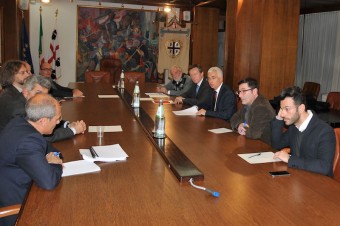 During the meeting, which included discussions on a framework agreement between the Autonomous Region of Sardinia and the Italian Space Agency, the potential developments of space astrophysics in Sardinia were addressed. This sector, thanks to the opportunities opened by the Sardinia Radio Telescope (SRT), is extremely interesting and promising in various fields.
“Aerospace is one of the sectors we strongly believe in,” stated RAS Vice President Paci at the conclusion of the meeting. “Now, thanks to the funding provided by Europe for this sector, we want to take a step forward, transforming basic research into job opportunities, wealth, and social growth for our region.”
After the meeting at the Region, ASI President Battiston, accompanied by INAF President D’Amico and technologists from the INAF-Cagliari Astronomical Observatory, visited the SRT site, the technology development laboratories, and the outreach facilities in the new Science Campus in Selargius.
“The technological excellence of SRT,” stated Battiston at the conclusion of his visit to Sardinia, “is based on a tradition in the field of radio waves where the INAF Observatory and the University of Cagliari play a fundamental role both in advanced research and in training new professionals, in line with an entirely Italian tradition of excellence in the space sector of radio waves. With the start of operations of the SRT radio telescope, the collaboration between ASI and INAF is enriched with an extraordinary tool, which with exceptional versatility is capable of observing both the most distant galaxies and satellites and debris orbiting the Earth, as well as communicating with satellites of interplanetary missions to Mars, Saturn, or Jupiter. Fundamental science is inextricably mixed with space applications, as are the infrastructures to operate and communicate with probes placed hundreds of millions of kilometers from Earth.”
The potential of the Sardinian radio telescope in the field of space sciences, through the existing collaboration between INAF and ASI, was already glimpsed recently with the success of SRT in capturing the signal sent by the Rosetta probe. And just a few weeks ago, SRT and the development laboratories of the Cagliari Observatory were the subject of a technical visit by important figures from the Jet Propulsion Laboratory JPL, NASA’s historic arm in the field of robotic explorations of our Solar System, precisely to explore the opportunities for integrating SRT into the Deep Space Network.
“The statements from the leaders of the Sardinia Region and President Battiston,” added Nichi D’Amico, “outline the start of a virtuous process of capitalizing on the investments made in Sardinia by INAF in collaboration with the Region, the University, and ASI, which today are also part of an ambitious wide-ranging development program of the Sardinia Aerospace District (DASS).” The collaboration between the Sardinia Region, INAF, ASI, DASS, and probably soon NASA, once again demonstrates that large infrastructures of high technological value and innovation like SRT represent a broad-spectrum development driver. The future of SRT, which among other things will begin its first official observation campaign in the coming weeks, looks increasingly exciting and full of opportunities for astrophysics and Sardinia.