by Nichi D’Amico
A hundred years ago, Albert Einstein formulated the Theory of General Relativity. A fascinating and elegant mathematical framework. The theory has profound implications for Gravitation and demonstrates the limits of Newton’s conception. To many, this might seem like a simple, albeit elegant, intellectual exercise, since after all, “Newton’s apple” continues to fall to the ground as before. In reality, Einstein’s theory has introduced spectacular changes, not only in our understanding of the Universe but also in our lives. Just think of the GPS, a device that could not function without the treatment of satellite orbits through Einstein’s theory. One of the most captivating aspects of this theory is the curvature of space-time generated by a mass in its vicinity.
 One of the consequences of this curvature phenomenon is the fact that if two masses orbit around each other, the deformation of space they produce generates a wave motion of space that propagates, the so-called gravitational waves: Newton’s apple placed near a system of stars orbiting each other (a binary system) begins to oscillate!
Until today, we have had indirect evidence of the existence of gravitational waves. For example, we have discovered binary systems whose orbit shrinks precisely due to the loss of energy caused by the emission of gravitational waves. It is predicted that, at the end of the approach process, the two stars will collapse onto each other, causing a “burst” of gravitational waves: an event we call a “merger.”
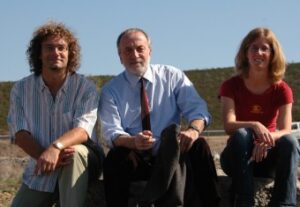
Nichi D’Amico (center), together with Marta Burgay and Andrea Possenti, at the time when they discovered the first binary system in an advanced phase of “coalescence,” destined to become a “merger” in relatively short timescales. Their article, published in Nature in 2003, demonstrated a substantial increase in the probability of detecting bursts of gravitational waves from these binary systems during the final phase of coalescence, like the one announced today by LIGO/Virgo.
I remember with emotion our discovery in 2003 of a binary system whose “orbital decay” was extraordinarily high, meaning a system relatively close to the final phase of “merger.” The article, published in Nature, made headlines worldwide, revitalizing the community’s interest in the direct search for gravitational waves through sophisticated measurement apparatuses like those of LIGO and VIRGO.
The sophisticated LIGO detector – a pair of four-kilometer-long tunnels where the propagation of a laser beam is measured with incredible accuracy, sensitive to any deformations of space-time produced by the passage of gravitational waves – has detected a “burst” of gravitational waves coming from a “merger” consisting of two black holes. This is undoubtedly a Nobel Prize-worthy discovery!
This result opens a new “channel” for observing the Universe, which will lead us to the discovery of new sources and new phenomena. And here lies a great future for INAF: to thoroughly observe these new sources with our powerful telescopes and study their nature. Our research groups already have an agreement with LIGO and VIRGO that allows us to be alerted in real-time to point our powerful telescopes, radio telescopes, X and gamma satellites to discover the nature of these new and intriguing sources of gravitational waves.
A new frontier is opening, on which the Italian astronomical community is at the forefront. New ideas will flourish, new instruments will be developed, and once again, we will engage, in collaboration with the national industry, in the development of new apparatuses, with great scientific and technological returns for the country.
In this interactive timeline, the main milestones that led to today’s result:
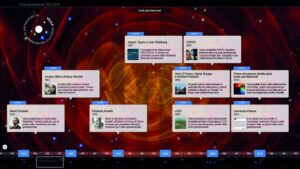
Click on the image to navigate the timeline.
Credits: Davide Coero Borga / Media INAF