
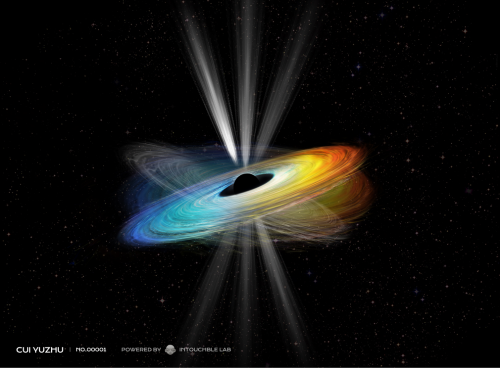
A group of researchers led by the Zhejiang laboratory (China), including the National Institute for Astrophysics (INAF) and the University of Bologna, recently discovered that the nearby radio galaxy Messier 87 (M87), located 55 million light-years from Earth, exhibits an oscillating jet. This jet originates from a black hole 6.5 billion times more massive than the Sun: precisely the one whose image was captured in 2019 with the Event Horizon Telescope (EHT). From data collected over the past 23 years using the Very Long Baseline Interferometry (VLBI) technique, experts observed that the jet oscillates with an amplitude of about 10 degrees (the phenomenon is known as precession). As stated in the article published today in Nature, experts have revealed a recurring 11-year cycle in the precession movement of the jet’s base, as predicted by Einstein’s general relativity for a black hole rotating around its axis. This work has successfully linked the jet’s dynamics with the black hole, demonstrating the connection between the jet dynamics and the rotating black hole.
The supermassive black holes at the center of active galaxies are the most powerful celestial objects in the universe, as they can accumulate enormous amounts of material due to their extraordinary gravitational force and simultaneously power jets that move away at speeds close to the speed of light. However, the mechanism of energy transfer between supermassive black holes, the disk through which matter falls onto the black hole, and the relativistic jets remains an unresolved enigma. A prevailing theory suggests that energy can be extracted from a rotating black hole, which, thanks to the gravitational energy obtained from the matter falling onto it, is capable of expelling plasma jets at speeds close to the speed of light. However, the rotation of supermassive black holes has not yet been proven with certainty.
Marcello Giroletti, a researcher at INAF, stated: “The precession is the variation in the direction of the jet emitted by the black hole at the center of M87. Specifically, it is a change that is regular and cyclic, causing the jet to describe a regular cone around an imaginary axis when projected onto the sky plane. Observing this precession projected onto the sky plane, we see the jet oscillate regularly.”
Indeed, what force in the universe can alter the direction of such a powerful jet? The answer might lie in the black hole’s rotation, which significantly impacts the accretion disk’s rotation axis, causing it to misalign with the black hole’s rotation axis, leading to the jet’s precession. If the black hole is rotating on its own axis, it significantly impacts the accretion disk’s surrounding matter, resulting in a dragging of nearby space-time, as predicted by Einstein’s General Relativity.
From the data analysis, it is evident that the rotation axis of the accretion disk is misaligned with the rotation axis of the black hole. This misalignment provides compelling evidence to conclusively determine that the supermassive black hole within M87 is rotating, opening up significant implications for understanding the surrounding space-time and the dynamics of the jet.
Data analysis reveals that the rotation axis of the accretion disk is misaligned with the rotation axis of the black hole, leading to the precession of the jet. The detection of this precession provides compelling support to conclusively determine that the supermassive black hole within M87 is rotating, opening new dimensions in our understanding of the nature of supermassive black holes.
“Precession,” says Giroletti, “is the variation in the direction of the jet emitted by the black hole at the center of M87. Specifically, it is a regular and cyclical variation in which the jet’s axis over the years describes a cone around an imaginary axis. Observing this precession projected onto the sky plane, we see the jet oscillate regularly.”
The analysis of the data reveals that the rotation axis of the accretion disk is misaligned with the rotation axis of the black hole. The detection of this misalignment represents convincing support for the conclusion that the supermassive black hole within M87 is indeed rotating.
The precession, says Giroletti, is the variation in the direction of the jet emitted by the black hole at the center of M87. By observing this precession projected onto the sky plane, we see the jet oscillate regularly.
Giroletti adds: “INAF made a fundamental contribution through the participation of its radio telescopes, which are located at a great distance (about 10,000 km) from those in East Asia that formed the core of the observational network. Since the details of the images depend on the network’s extension, the addition of INAF’s antennas improved the image detail by almost 10 times. This greatly facilitated the detection of the jet’s oscillations. Additionally, INAF contributed with its research staff’s participation in interpreting the results.”
The analysis of the data shows that the rotation axis of the accretion disk is misaligned with the rotation axis of the black hole, leading to the jet’s precession. This detection of precession provides convincing support to conclusively determine that the supermassive black hole within M87 is rotating.
For further information:
A twenty-year study just published in Nature has identified, without a doubt, that the supermassive black hole within the galaxy M87 is rotating. INAF also participated with the Medicina antennas and Sardinia Radio Telescope.