
The outer Galaxy: structure, star formation, and chemistry
- Date:
- Speaker: Dr. Dario Colombo
- Affiliation: Argelander-Institut für Astronomie (Bonn, Germany)
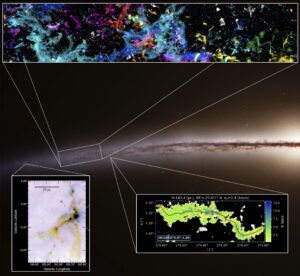
Star formation is ubiquitous in the Milky Way, but the physical and chemical conditions of star-forming environments vary with Galactocentric radius. The negative metallicity gradient reduces the availability of heavy elements and dust in the outer Galaxy, affecting gas cooling and dust shielding. At the same time, weaker interstellar radiation fields and lower cosmic-ray fluxes reduce gas heating, potentially leading to lower gas temperatures. The interplay between these processes shapes the thermal and chemical state of the interstellar medium and may influence the efficiency of star formation.
In this talk, we will present highlights from the recently completed APEX legacy survey “Outer Galaxy High Resolution Survey” (OGHReS), which covers approximately 100 deg² in the third Galactic quadrant in the CO(2–1) transition and its rare isotopologues. Through it, we will explore the structure of the outer Galaxy and highlight key differences from the inner Milky Way. Using SCIMES, a machine-learning-based algorithm for molecular cloud identification, we identified approximately 25,000 molecular clouds, which appear, on average, less massive and less dense than their inner-Galaxy counterparts. Similarly, large-scale filaments in the outer Galaxy have linear masses approximately an order of magnitude lower than those in the inner Galaxy of comparable size, and are predominantly quiescent. These findings are consistent with a declining trend in the luminosity-to-mass ratio (L/M), suggesting less efficient high-mass star formation in the outer Galaxy. This trend was inferred by refining the velocity assignments of Hi-GAL sources using our spectroscopic data. Moreover, outer-Galaxy filaments are found exclusively in inter-arm regions, potentially pointing to formation mechanisms that differ from those operating in the inner Milky Way.
Despite this overall picture, notable exceptions reveal the complexity and poorly understood phenomena that drive the star formation in the outer Galaxy. Falkor, the most prominent filament identified in the survey, hosts active star formation and a hot-core candidate, while the λ-complex constitutes one of the most massive star-forming hub Milky Way, although being located in the extreme outer Galaxy.
Further, we will also present preliminary results from follow-up observations of selected star-forming clumps in additional molecular and atomic transitions, examining how their physical and chemical properties vary across the Milky Way. To conclude, we will discuss the extent to which the outer Galaxy provides a natural laboratory for investigating star formation under lower-metallicity conditions, and identify the observational and theoretical advances needed to understand star formation across the diverse environments of our Galaxy.
Dr. Dario Colombo, Argelander-Institut für Astronomie (Bonn, Germany)
Dario Colombo obtained his PhD from Heidelberg University, where he conducted his doctoral research at the Max Planck Institute for Astronomy. After postdoctoral positions at the University of Alberta and the Max Planck Institute for Radio Astronomy, he is now a Senior Scientist at the Argelander Institute for Astronomy (University of Bonn). His research focuses on galaxy evolution, particularly the processes driving star formation quenching, through the study of the distribution and physical properties of cold gas, from the Milky Way to nearby galaxies.