
Static and Spherically Symmetric Wormholes: Revealing Their Signature through Epicyclic Frequencies
- Data:
- Speaker: Dr. Vittorio De Falco
- Affiliation: Scuola Superiore Meridionale (Italy)
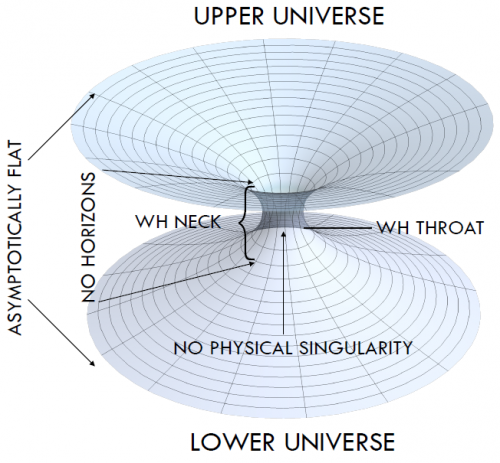
Image caption: Geometry of a wormhole (WH) endowed with a bridge, usually called WH throat, connecting two universes (supposed to be asymptotically flat), and having neither horizons nor physical singularities.
In this talk, I speak about wormholes, which are exotic astrophysical objects endowed with no horizons and physical singularities, characterized by a throat that connects two different parts of the same or different universes. Although they are widely studied from a theoretical point of view, there are not yet observational evidences of their existence. For such a reason, I, together with other collaborators, have developed an astrophysical technique based on the concept of epicyclic frequencies, which is a strategy widely used in high-energy astrophysics to infer information on a given self-gravitating system and on the related gravity background. I explain how to detect the signature of a wormhole (distinguishing it from a black hole) and how to reconstruct wormhole solutions through the fit of the observational data. Finally, I discuss the implications of the proposed epicyclic method.
Brief CV of Dr. Vittorio De Falco:
He was born in Naples and graduated in Mathematics at the University of Naples “Federico II” with a thesis in Cosmology under the supervision of Prof. Salvatore Capozziello and Prof. Antonio Romano. He then moved to Switzerland, where he started a Ph.D. in Theoretical Physics, enrolled at the University of Basel and also working at the International Space Science Institute in Bern under the supervision of Prof. Maurizio Falanga, Prof. Luigi Stella, and Prof. F. K. Thilemann. In July 2018, he defended his doctoral thesis on the Poynting-Robertson effect in General Relativity and its applications to accretion phenomena in high-energy astrophysics. Subsequently, he held Postdoc positions at the University of Opava (Czech Republic), at the Stefanik Observatory and Planetarium (Slovak Republic), and (currently) at the University of Naples “Federico II”. His research topics are mainly focused on General Relativity and its applications in high-energy astrophysics around compact objects, such as black holes, neutron stars, and wormholes. In particular, he has contributed to the advancement of the Poynting-