High-accuracy Polarization Measurements at Millimeter and Sub-Millimeter Wavelengths from Ground and Space
- Data:
- Speaker: Dr. Alessia Ritacco
- Affiliation: LPENS/IAS (France)
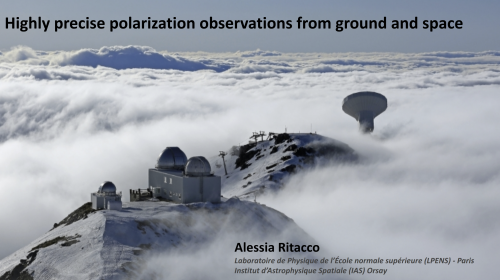
Multi-wavelength polarization observations at different angular resolutions are fundamental to probe a number of astrophysical processes from galactic to cosmological scales. In particular, dust polarization measurements at intermediate and high angular resolution of filamentary regions in our galaxy are key to uncovering the role of magnetic fields in the star formation process. On the other hand, the search for the cosmic microwave background (CMB) polarization B-modes signal, to unveil the primordial universe, drives the motivation for technological developments and advances in data analysis techniques.
The measurement of these very weak polarization signals requires unprecedented sensitivity, control of the systematic effects generated by the instruments, and very precise calibration.
In this seminar, I will overview the progress in the field to overcome these difficulties in the context of the NIKA2 camera, which observes from the IRAM 30m telescope in Spain, and also the development of the future satellite LiteBIRD.
Brief CV of Dr. Alessia Ritacco:
Born in Calabria, Alessia moved to Rome to study astrophysics at La Sapienza University, earning her degree in experimental cosmology in the fall of 2012. In 2013, she moved to Grenoble for a doctoral thesis funded by the French space agency (CNES). There, she worked on technologies for detecting polarized millimeter emission from the sky using the NIKA/NIKA2 camera installed on the 30m IRAM radio telescope in Spain. In 2017, she began a post-doc at IRAM, focusing on NIKA2 observations and the commissioning of the final polarimeter. In the fall of 2019, she moved to Paris to work on the development of the mid-high frequency telescope for the LiteBIRD satellite and the behavior of the spatial variation of the SED of dust polarization as a foreground for detecting CMB polarization B-modes.