
Detection of Alpha Centauri at Radio Wavelengths: Chromospheric Emission and Search for Star-Planet Interaction
- Date:
- Speaker: Prof. Dr. Corrado Trigilio
- Affiliation: INAF - Astrophysical Observatory of Catania (Italy)
Abstract
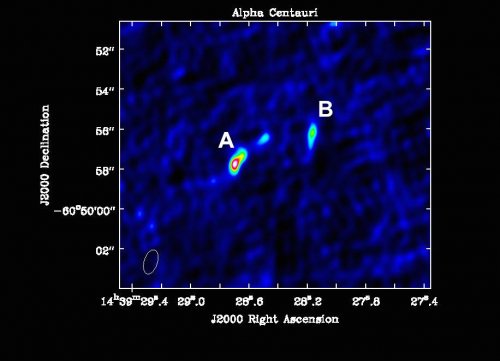
The Sun is one of the brightest radio sources in the sky. However, if we project the Sun to the distance of nearby stars, its emission is so faint that no radio telescope or interferometer would have been able to detect it at centimeter wavelengths so far. Nevertheless, the information that can be derived from radio observations is of great importance for the study of stellar atmospheres and their surroundings. The new generation of radio interferometers has enough sensitivity to detect the closest solar-type system, Alpha Centauri, which we observed with ATCA at 17 and 2.1 GHz. In this talk, I’ll present the results of these observations and what can be derived about atmospheric profiles and magnetic activity. Another important potential is the possibility to detect auroral radio emission generated by the interaction of the stellar magnetosphere and an orbiting planet. Even though the claimed discovery of an Earth-like planet around Alpha Cen B at the time of our observations is now ruled out, I take the opportunity to discuss the Auroral Radio Emission due to Electron Cyclotron Maser, which could be of great importance to detect planetary magnetic fields, whose presence is important for habitability and life protection in Earth-like exoplanets, and our ongoing work in this field.