
Dissecting the Gamma-Ray Galactic Center Excess
- Date:
- Speaker: Dr. Silvia Manconi
- Affiliation: RWTH Aachen University (Germany)
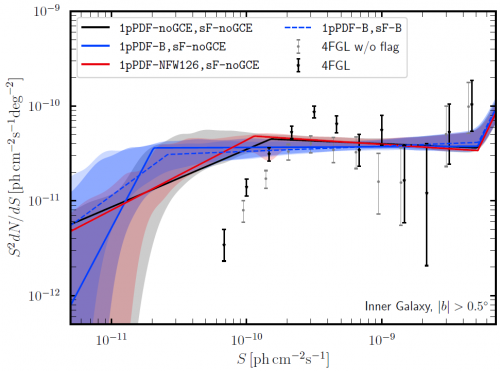
Image caption: Count distribution of sources as a function of gamma-ray
flux S (i.e., dN/dS) in the inner Galaxy. Points: dN/dS of sources in the fourth Fermi-LAT catalog. Lines: dN/dS as measured by pixel count statistics (1pPDF) adopting
interstellar background emission models optimized with adaptive template fitting (SF-). This permits to robustly measure the dN/dS about one order of magnitude below the catalog threshold.
Abstract: The Galactic center excess (GCE) is an unexpected gamma-ray component over astrophysical background detected at GeV energies towards the Galactic Center by the Fermi-Large Area Telescope (LAT).
Intriguingly, the GCE could be hinting at Weakly Interacting Massive Particles annihilating in the Galactic dark matter halo. Moreover, it could also be due to a population of millisecond pulsar-like sources emitting below the threshold of current Fermi-LAT catalogs. In order to disentangle between different interpretations, a detailed analysis of its morphology and spectral characteristics should deal with the
systematic uncertainties coming from the interstellar background emission, which dominate the observed photons. A plethora of techniques has been recently used to further investigate the GCE, ranging from template fitting, photon-count statistics to machine learning.
In this talk I will review our current understanding of the GCE, illustrating both technical developments as well as their consequences for the interpretation of the excess. I will focus on recent efforts to minimize the mismodeling coming from the interstellar background emission, by combining for the first time [1] adaptive template fitting and pixel count statistics in order to robustly assess the role of
sub-threshold point sources.
[1] Calore, Donato, Manconi, Phys. Rev. Lett. 127, 161102 2021
Brief CV of Dr. Silvia Manconi:
Dr. Silvia Manconi was born and raised in Sardinia. She received her Bachelor’s Degree in Physics from the University of Cagliari in 2012. She then moved to Turin, where she first obtained her Master’s Degree in 2015 and then her PhD in Physics and Astrophysics in 2019. Silvia’s doctoral thesis was awarded the Fubini Prize by the INFN in 2019 for the best thesis in theoretical physics discussed in Italy. Since October 2019, she has been a postdoctoral researcher at the Institute for Theoretical Particle Physics and Cosmology (TTK) at RWTH University in Aachen (Germany).
Silvia’s research focuses on various aspects of particle physics theory, ranging from the search for dark matter signals in cosmic rays and gamma rays to the study of Galactic and extragalactic cosmic ray accelerators using multi-frequency techniques.