
New High-Frequency Radio Observations of the Cygnus Loop SNR
- Date:
- Speaker: Dr. Sara Loru
- Affiliation: INAF - Astronomical Observatory of Catania (Italy)
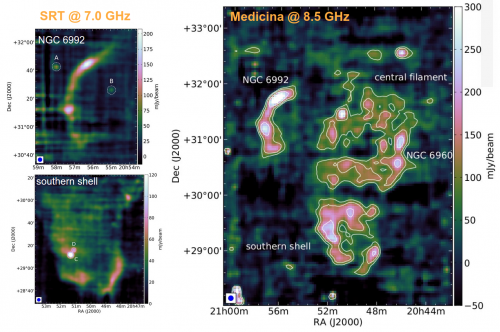
Abstract: Supernova remnants (SNRs) result from the stellar mass ejected during a supernova explosion, and their spatial and temporal evolution is strongly related to the interaction between the SNR shocks and the surrounding interstellar medium (ISM).
Thanks to its large size, its location well out of the Galactic plane, and its high brightness, the middle-age SNR Cygnus Loop is well suited for observations across the entire electromagnetic spectrum. In the radio band, this SNR presents a very characteristic morphology with a large northern circular shell and a bubble-like shell located in the southern part.
The radio studies showed substantial differences between these two regions, which could be related to the local magnetic field conditions, particle populations with different energy distribution or peculiar emission mechanisms. Despite this scientific interest, sensitive flux density measurements are missing at higher frequencies (above ∼ 5 GHz), due to the technical difficulties in performing radio continuum observations of such a large source. These arguments made Cygnus Loop a very interesting target to observe with the Italian radio telescopes.
I will present the work based on single-dish observations of the large and complex Cygnus Loop SNR from 7.0 to 24.8 GHz with the Medicina and the Sardinia Radio Telescope. These observations allowed us to investigate the radio spectrum of Cygnus Loop in a yet unexplored frequency range, and to study the energetics of the accelerated particles and the possible emission mechanism that takes place in this SNR.
These results highlight that SNRs are an interesting challenge for new generation radio telescopes and powerful laboratories to study theoretical aspects of Cosmic-Ray acceleration processes.
Brief CV of Dr. Sara Loru:
She obtained her master’s degree at the University of Cagliari with a thesis dedicated to the first C-band observations of extended sources such as SNRs with SRT as part of its scientific validation phase. In 2019, she earned her PhD at the University of Cagliari in collaboration with INAF-Astronomical Observatory of Cagliari with a project dedicated to the study and spectral characterization of SNRs through single-dish radio observations. Since 2019, she has been working as a PostDoc at INAF-Astrophysical Observatory of Catania with a research grant dedicated to the study of galactic SNRs observed with SKA precursors and pathfinders.