
The Italian FRB Network: from the Lowest Frequencies to the Highest Energies*
- Date:
- Speaker: Dr. Maura Pilia
- Affiliation: INAF - Astronomical Observatory of Cagliari (Italy)
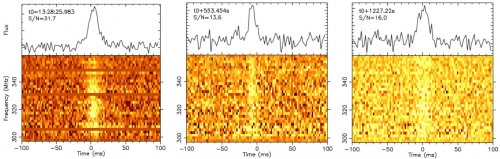
Abstract: Fast Radio Bursts (FRBs) are fast, millisecond-duration, extremely bright (~Jy) bursts that have so far only been observed at radio wavelengths. Only a small fraction of them, the so-called repeaters, have been observed more than once and their multiple detections have shaped the theories on their -still nebulous- origin.
FRB180916 is probably the most active known repeater and is the closest one to have been localized. Its proximity and its high activity level led, soon after its discovery, to the first-ever detection of periodicity from FRBs. This source is active for about 5 days within a cycle of 16 days. Its close proximity and the predictability of its bursts made it the ideal target both for in-depth studies in the radio band and for the -so far elusive- search of a multiwavelength counterpart.
I will present the results of a multiwavelength campaign performed using SRT observations at P and L bands reaching the first detection of FRBs below 400 MHz, and constraining upper limits on their emission at optical and X-ray bands at millisecond timescales.
This campaign was but a starting point for the ongoing Italian effort at tackling FRBs. I will give a panorama of this collaboration, starring a growing community from the radio domain (including the Northern Cross and the VLBI, along with SRT) up to gamma-rays.
Brief CV of Dr. Maura Pilia:
She obtained her Bachelor’s degree in Cagliari and her Master’s degree in Bologna, then earned her PhD in Como with co-supervision by Dr. Alberto Pellizzoni on pulsar studies from radio to gamma. After her PhD, she first got a Post-doc at ASTRON in the Netherlands to work with the LOFAR pulsar group, and then a Post-doc at INAF-OAC. In the latter, she initially worked on the creation of databases and pipelines for multi-frequency pulsar analysis; then on the development of tools for pulsar polarization studies with SRT and the future IXPE satellite.
Since July 1, 2020, she has held a staff position at INAF-OAC. She currently works mainly on Fast Radio Bursts in radio and multi-frequency, and on the development of SRT, Northern Cross, and IXPE for observations of neutron stars and fast transients.