
Star Clusters as Laboratories for Exotic Stellar Populations
- Data:
- Relatore: Dr. Mario Cadelano
- Affiliazione: Osservatorio di Astrofisica e Scienza dello Spazio di Bologna (OAS, INAF)
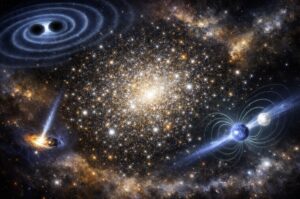
Star clusters are fundamental building blocks of galaxies and key tracers of their star formation and assembly histories. At the same time, their high stellar densities make them collisional systems in which two-body relaxation and repeated binary–single and binary–binary encounters govern long-term evolution. As a natural consequence, dense star clusters overproduce exotic stellar populations thatare rare in the Galactic field, including blue straggler stars, millisecond pulsars, X-ray binaries, and compact-object binaries formed through dynamical channels. Therefore, within the cluster environments, stellar dynamics does not merely perturb stellar evolution: it actively reshapes it.
In this talk, I will present results from a long-term observational and modeling program aimed at systematically characterizing exotic stellar populations across a broad sample of star clusters. I will discuss what we have learned about their formation channels and emphasize how these objects can be used as probe particles to investigate internal cluster dynamics, stellar evolution in dense environments, and to test aspects of fundamental physics. Finally, I will discuss how dynamical binary evolution in cluster cores, including hardening through repeated encounters and hierarchical mergers, can lead to the formation of gravitational-wave progenitors. I will also discuss how these processes connect to the ongoing search for intermediate-mass black holes, which are expected to reside in the most massive star clusters, presenting the current state-of-the-art observational and modeling efforts aimed at detecting these elusive objects.
Dr. Mario Cadelano, Osservatorio di Astrofisica e Scienza dello Spazio di Bologna (OAS, INAF)
I am a tenure-track researcher at the University of Bologna, specializing in resolved stellar populations through multi-wavelength observations and modeling. I obtained my PhD in Bologna, focusing on millisecond pulsars in globular clusters, and subsequently held a fellowship at INAF-OAS studying multiple populations in star clusters. I also spent a research period at NRAO in Charlottesville, working on radio observations of pulsars. I have served as a work package coordinator in projects such as LIGHT-on-DARK and Genesis, and I am currently a member of several international collaborations focused on star cluster science, including Cosmic-LAB, TRAPUM, SGWS, and BoET.